
Beyond Predictive Maintenance: AI for Proactive Anomaly Detection and Waste Reduction in Manufacturing


By Jon Lee, a Google-certified digital expert with 12+ years experience who brings depth and creative storytelling to emerging technology topics.
Reviewed By Brian McCracken, AI Strategy Expert at The Provato Group, combining AI/machine learning and frontend development to create intelligent, discoverable web experiences.
January, 2026
AI allows for proactive anomaly detection and waste reduction in manufacturing by using a combination of machine learning (ML) algorithms and deep learning models with IoT sensors, computer vision, and edge computing.
Empowering your manufacturing organization with AI is becoming more of a competitive necessity than ever. As a 2025 study by Lawal Qudus from the International Journal of Computer Applications Technology and Research discusses, manufacturers in the world of Industry 4.0 will find themselves struggling “to adapt to the dynamic and complex nature of contemporary manufacturing environments … the inability to process vast datasets in real time have often led to production delays, cost overruns, and suboptimal output.”
But with AI being capable of analyzing massive datasets and making data-driven decisions, running into the problems stated above can be mitigated faster and more efficiently than by manual human effort alone.
This allows manufacturers to go beyond traditional predictive maintenance, tapping into broader data to find more inefficiencies, optimize workflows, detect outliers in processes, and prevent both process waste and machine failure from occurring in the first place.
Let’s take a closer look at proactive anomaly detection in manufacturing, how AI enables real-time anomaly prediction, the role of IoT and Edge AI gather real-time data, the importance of data quality and sensors for supporting AI, and how feedback loops and retraining are crucial.
- 1. What is Proactive Anomaly Detection in Manufacturing?
- 2. How AI, IoT, and Edge Computing Enable Real-Time Anomaly Detection
- 3. Real-World Case Study Examples
- 4. Why Are Data Quality and Sensors Crucial for Supporting AI?
- 5. How Do Feedback Loops and Retraining Keep AI Optimized?
- 6. Make Your Manufacturing More Efficient With AI
What is Proactive Anomaly Detection in Manufacturing?
Proactive anomaly detection in manufacturing is the use of AI and ML to analyze your real-time sensor and production data, using that data to train and create a baseline to search for anomalies that deviate away from the “normal” baseline.
By identifying oddities and deviations, you can prevent anomalies from turning into losses, downtime, or waste. This in turn increases your overall productivity and improves your resource use.
But to ensure your AI performs its proactive anomaly detection properly, you’ll want to understand how AI is trained to find anomalies and alert its users.
How AI, IoT, and Edge Computing Enable Real-Time Anomaly Detection
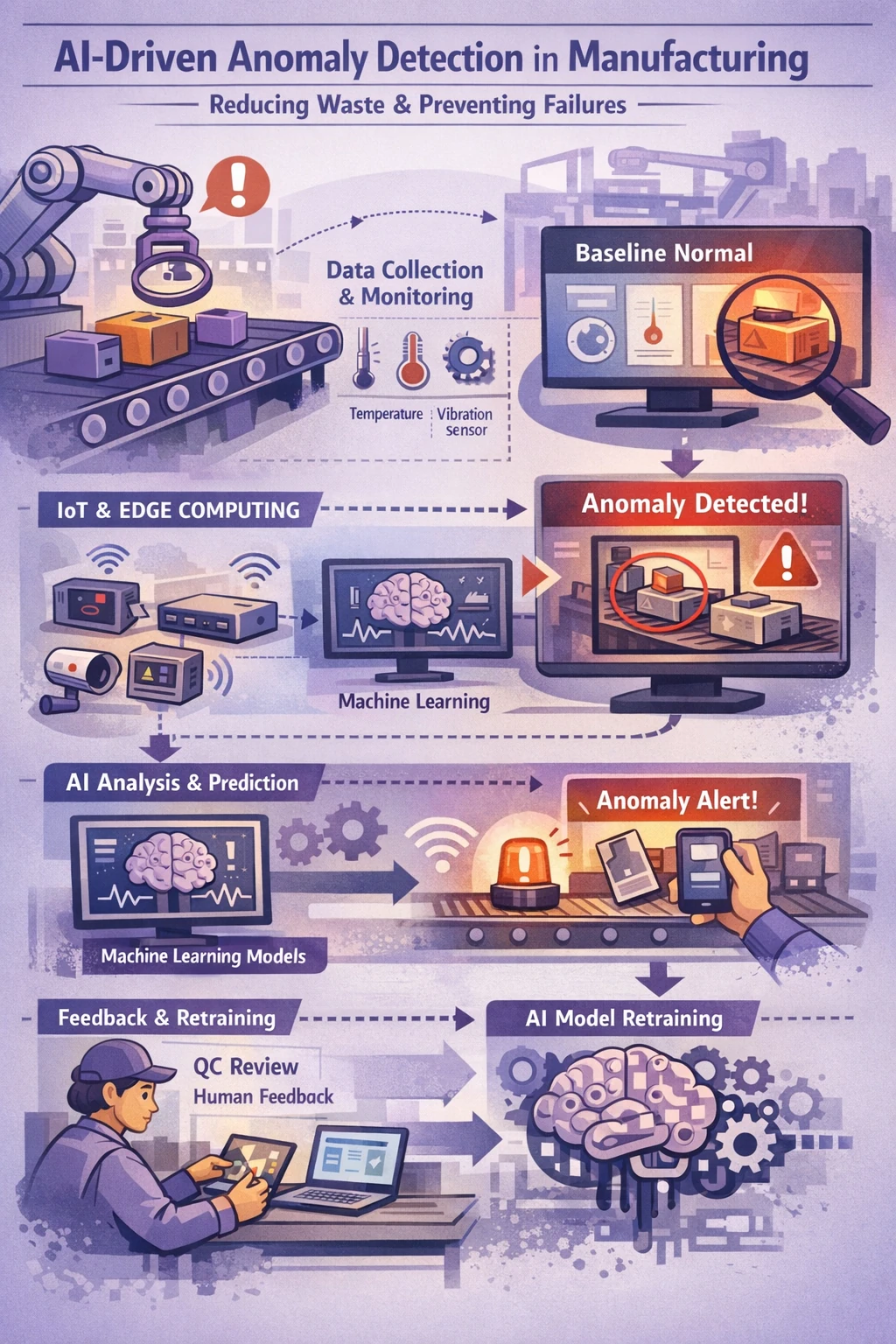
Proactive anomaly detection in manufacturing follows a structured workflow that allows AI systems to identify deviations in real time and prevent failures, waste, and downtime.
Proactive Anomaly Detection Workflow
- Data Collection
- Baseline Normal Behavior
- Real-Time Monitoring
- Anomaly Identification
- Proactive Alerts and Notifications
The workflow outlined above is executed through a combination of AI models, IoT sensor networks, and edge computing infrastructure.
Data collection is done through IoT sensors, high-resolution cameras (computer vision), machine logs, and SCADA (Supervisory Control and Data Acquisition) systems. These devices gather real-time data from machinery and production lines and transmit it to local edge computing devices located on the factory floor.
At the edge, this data is cleaned, filtered, and normalized to remove noise and prepare it for analysis. This preprocessing ensures that only high-quality, relevant data is passed to AI and ML models.
Using this data, AI models develop a baseline of “normal” behavior by analyzing large volumes of historical and real-time data. This baseline creates a dynamic profile of expected performance across machines, processes, and workflows.
During real-time monitoring, AI continuously compares live data streams against the learned baseline. When a data point or pattern deviates beyond acceptable thresholds, the system flags it as an anomaly.
ML models such as autoencoders, LSTM neural networks, and isolation forests are commonly used to detect complex patterns and deviations in sensor and time-series data. For image-based defect detection on assembly lines, deep learning models such as Convolutional Neural Networks (CNNs) are used to identify visual anomalies and quality defects.
When an anomaly is detected, the system can issue proactive alerts and notifications containing contextual information about the issue. In some cases, the AI may also trigger automated actions such as scheduling maintenance, adjusting a process, stopping a machine, or initiating a quality check.
Because this analysis occurs on edge devices close to the source of the data, response times are significantly faster than cloud-only approaches. This low-latency processing allows manufacturers to detect and address issues before they escalate into equipment failure, downtime, or waste.
Optionally, anomaly data can be sent to the cloud for long-term storage, deeper analysis, and model retraining, supporting continuous improvement of the AI system over time.
Real-World Case Study Examples
Real-world case study examples of AI being used for proactive anomaly detection can be found in the companies of Siemens and Bosch and their manufacturing innovations:
Siemens
In a 2025 report from Arm Newsroom, Siemens utilized real-time edge AI to give predictive maintenance an upgrade by cutting down on latency and trading periodic sensor readings found in conventional systems with the real-time analysis provided by embedded edge AI.
Using Armv9-based AI-powered sensors, Siemens was able to “continuously monitor vibration patterns, temperature fluctuations, and energy draw in motors, conveyors, and actuators”. What’s more, whenever their system detected an anomaly, “it doesn’t just send an alert. It can automatically adjust machine parameters in real time”.
Bosch
In a 2023 report by Bosch, the company detailed how one of their plants in Bavaria was using AI for quality control. At their Immenstadt site, their AI was trained to search for defects in components for ABS systems. Anytime a defect was detected, the test bench’s screen would light up red to alert assembly workers of the anomaly detection. The AI continuously improves through weekly retraining.
Now you know how AI is being applied for proactive anomaly detection in today’s world. But none of this would be possible without two crucial components: sensors for gathering data and quality data for your AI system.
Why Are Data Quality and Sensors Crucial for Supporting AI?
Data quality will be what determines how well your AI can perform, and high-quality sensors will be necessary to gather the proper data to feed your AI.
To achieve high-quality data, your organization should have consistent logging, established data pipelines, and high-resolution sensors that are well-calibrated. Good data must be clean, diverse, and relevant. This helps create a more reliable, stable, and unbiased model—this is essential, especially when you’re trying to detect anomalies and avoid waste and machine failure.
If you have poor quality data, outdated sensors, or inconsistent logging, your AI will suffer in performance as its conclusions become flawed, and it will lead to missed anomalies, quality issues, unanticipated failures, and wastage.
Even when your AI is performing well, it can always get better. That’s why AI models require retraining and feedback loops to maintain optimization.
How Do Feedback Loops and Retraining Keep AI Optimized?
Feedback loops and retraining keep AI optimized in two stages:
- Feedback loops serve to gather data that is verified by a human
- Retraining serves to integrate the verified data gathered from the feedback loops to update the AI model
Feedback Loops
Feedback loops work through cooperation between AI and a human reviewer. Whenever the AI flags an anomaly, a human, such as a quality control engineer, will check to verify the result and confirm if the defect is true or if there was a false positive/negative scenario. The quality expert can then correct the AI’s decision if needed. If corrections are necessary, the human staff can provide accurately labeled data as input to keep the AI grounded and true.
Retraining
Retraining is a continual process where the information gathered from the feedback loop is incorporated into the AI. This helps the AI adapt to model drift and changes to your manufacturing processes. It also aids your AI in learning of new types of defects to look out for. Finally, retraining serves to optimize the AI and prevent bias from emerging.
Through continuous improvement, your AI-enhanced anomaly detection protects your manufacturing from defects and oddities, even as manufacturing processes evolve and new types of anomaly-related issues arise. It is crucial to maintain this cycle of improvement for your AI to be a success.
Make Your Manufacturing More Efficient With AI
As you can see, leveraging AI for proactive anomaly detection protects against more than just wastage from defects and overproduction scrap—it makes your manufacturing more efficient! AI-powered anomaly detection empowers your manufacturing teams to make faster decisions, be proactive in maintenance, and save time from unplanned downtimes, stoppages, and micro-inefficiencies that would otherwise be hard to notice.
To ensure your AI for proactive anomaly detection is made to fit your unique manufacturing workflows and processes, consider enlisting the services of a custom AI developer like The Provato Group. Our AI development expertise can be applied to any part of your manufacturing organization, from your office to your factory floor.