


By Brian McCracken, AI Strategy Expert at The Provato Group, combining AI/machine learning and frontend development to create intelligent, discoverable web experiences.
October 2025
They say that “any press is good press.”
Something tells me they have never had their company dragged into the headlines for a data leak, or decisions an AI made that they can’t explain.
It doesn’t matter what line of business you’re in; a single algorithmic failure will undo years of brand building and shareholder trust.
Imagine you have an automated AI system that reviews resumes.
Suddenly it develops a bias against a protected group of people, and you might never know about it.
Now you’re on the front page for discrimination, completely blindsided by the news, all because a system drifted due to incorrect data.

To take another example, imagine you have an AI chatbot on your website.
Customers use it, are generally happy with it, and it saves you a great deal of money.
A real win-win situation.
Now imagine that same chatbot starts dumping out all of your customers’ private data one night to anyone and everyone.
Credit card numbers, checking account details, and personally identifiable information. The sky is the limit in how bad it could get.
Responsible AI prevents that.
It’s the firewall between innovation and disaster.
Responsible AI could be what separates you from being a market leader or becoming a case study in what went wrong.
- 1. What Is Responsible AI?
- 2. Why Is Responsible AI Important?
- 3. What Are the Principles of Responsible AI?
- 4. How Does the MECE Framework Apply to Responsible AI?
- 5. Can AI Be Responsible and Trustworthy?
- 6. What Are Common Barriers to Implementing Responsible AI?
- 7. What Is Ethical vs Responsible AI?
- 8. Who Is Responsible for AI?
- 9. Who Is Responsible for AI Mistakes?
- 10. Who Is Responsible for Autonomous AI?
- 11. Can AI Be Held Legally Responsible in Court?
- 12. What Is the Responsibility Gap in the Context of AI?
- 13. How Do Regulations and Frameworks Address AI Responsibility?
- 14. How to Use AI Responsibly
- 15. How Can Businesses Use AI Ethically and Responsibly?
- 16. What Metrics and KPIs Should Organizations Use to Measure Responsible AI?
- 17. What Is the Responsible Use of Generative AI?
- 18. Why Is It Important to Combine Responsible AI with Generative AI?
- 19. What Are the Specific Risks of Generative AI in Business Settings?
- 20. How to Build AI Responsibly
- 21. How to Implement Responsible AI
- 22. What Is the Developer’s Role in Responsible AI Integration?
- 23. What Are the Costs of Irresponsible AI vs. Investing in Responsible AI?
What Is Responsible AI?
Responsible AI (RAI) is the approach used by developers to create AI models and systems that follow ethical standards, making sure that those systems are safe, trustworthy, transparent, and aligned with human values.
Responsible AI is more than just ethics. It is a larger framework for the implementation of and adherence to societal and legal standards. Prioritizing the use of responsible AI is becoming a larger priority for organizations that realize they can be held accountable for a model’s output.
Prioritizing responsible AI during development creates models that are fair, protect private information, and are inclusive by design. It results in AI applications that are safe and ethical to use, mitigating harm to individuals, the environment, and society.
Responsible AI is not a ‘nice-to-have’ but a required part of any AI implementation strategy.

Why Is Responsible AI Important?
Responsible AI is important because:
- It protects organizations and society against biased outcomes
- Protects and scales against current and future regulation and compliance demands
- Safeguards the long-term viability of solutions built, keeping them sustainable and resilient
- Builds trust by promoting the explainability of the system and how it operates
Many business leaders think of AI as a black box. The view that is often expressed is that data goes in, they aren’t sure what happens next, and then it produces an output.
Responsible AI resolves that issue by creating systems that build trust with users. By removing the ambiguity and unknowns, people understand the system they are using and what goes into how it makes its predictions.

What Are the Principles of Responsible AI?
The four key principles of responsible AI are:
- Transparency (data privacy, explainability, and documentation)
- Governance (accountability, designated oversight, and liability preparedness)
- Fairness (bias mitigation and equal outcomes)
- Sustainability (reliability, safety, and risk management)
These principles guide the development and deployment of responsible AI systems. Together, they are a complete framework that protects organizations and users alike.

What Does the Principle of Transparency in Responsible AI Emphasize?
The principle of transparency in responsible AI prioritizes users and stakeholders understanding how the AI solution works and how it generates its predictions. It eliminates the “black box” problem many AI systems face by providing solutions that are explainable and well documented.
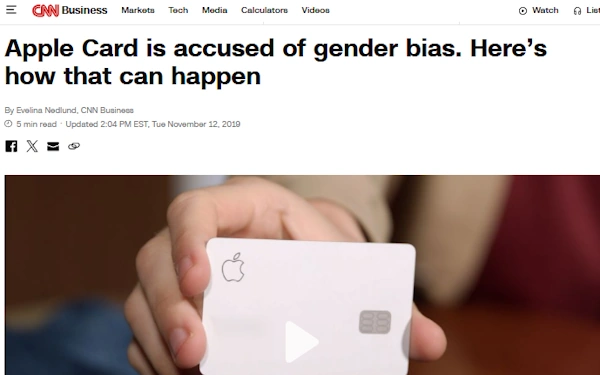
A lack of transparency has had real-world implications for businesses. In 2019, Apple and Goldman Sachs faced allegations of gender discrimination based on their system’s automated outputs. Their inability to explain how their system worked weakened their position.
While ultimately cleared of intentional discrimination in 2021, the New York Department of Financial Services (NYDFS) report found issues with the “black box” nature of their system, which undermined consumer trust and could create unequal outcomes.
Responsible AI promotes transparency, which was a problem Apple faced in allegations they were ultimately cleared of in 2019.
What Does the Principle of Governance in Responsible AI Emphasize?
The principle of governance in responsible AI aims to establish designated responsibility for AI outcomes and the creation of liability frameworks. This doesn’t mean that a single person is responsible for the whole system; rather, areas of responsibility are clearly defined between developers, operators, and organizations over a system’s lifecycle.
Eliminating ambiguity for who is at fault with established liability frameworks helps prevent incidents before they occur. It creates an environment where responsible parties are motivated to follow through with proactive risk management and standards adherence over the entire lifecycle of an AI product.
What Does the Principle of Fairness in Responsible AI Emphasize?
The principle of fairness in responsible AI attempts to remove bias from AI systems and avoid discretionary outcomes based on protected characteristics such as race, gender, age, religion, etc. If fairness isn’t addressed seriously, it can result in social risks to society and legal liability for the organizations operating the affected AI systems.
Issues with AI system fairness can result from system design, datasets that contain biased information, or a combination of both. After a model is designed, built, and deployed, it is important to monitor it for drift. Drift can cause bias to begin to manifest in the system over time, in which case the model may need to be retrained or have its design modified to account for the issue(s) causing the drift.
What Does the Principle of Sustainability in Responsible AI Emphasize?
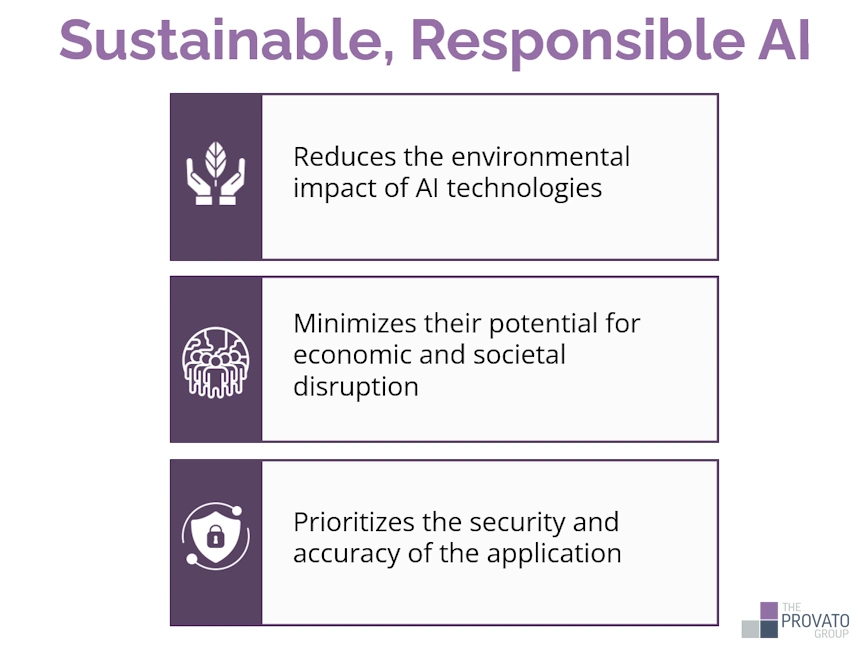
The principle of sustainability in responsible AI focuses on:
- Reducing the environmental impact of AI technologies
- Minimizing their potential for economic and societal disruption
- Prioritizing the security and accuracy of the application
These elements are the foundation of AI sustainability to prevent unintended harm.
How Does the MECE Framework Apply to Responsible AI?
The MECE (Mutually Exclusive, Collectively Exhaustive) framework applies to AI as a comprehensive approach to ethical decision-making, helping developers identify potential system bias by segmenting data into nonoverlapping buckets of information. Using MECE significantly reduces the likelihood of ethical issues, improves transparency, and makes the system easier to understand for both developers and stakeholders alike.
An analogy for it is organizing the utensil drawer in your kitchen. Without organization, all of the spoons, knives, and forks are just in a pile, mixed together. With organization, everything has its own exclusive place, and nothing is missing.
That organization is how you can think about MECE with responsible AI. Each responsible AI principle has its own clearly defined space, whether that be fairness or transparency. By using MECE, not only is everything separated, but everything is also meticulously covered; no important principle is forgotten or lacks clear ownership.
Can AI Be Responsible and Trustworthy?
Yes, AI can be responsible and trustworthy, but it will depend on several factors including:
- The quality of the data used for training
- Model design that prioritizes fairness, transparency, and safety
- Built with ethics at the forefront to align with societal values
- Continued human-in-the-loop oversight to monitor outcomes
If the data used for training or the design of the model is flawed in some manner, the model won’t be trustworthy. The same problem will occur if there’s nobody monitoring the predictions for accuracy and bias over time.
Responsible and trustworthy AI is not achieved through complexity but rather the technical implementation of social responsibility and human collaboration. It isn’t our replacement. It’s a reflection of our values, priorities, and responsibilities.
What Are Common Barriers to Implementing Responsible AI?
The common barriers to implementing responsible AI include:
- Technical and data barriers (poor data quality, lack of standardized guidelines, integration challenges, insufficient infrastructure)
- Organizational and cultural barriers (ambiguous roles, lack of clear responsibilities, lack of leadership buy-in, resistance to change, insufficient training, unclear accountability, cultural inertia)
- Financial and resource barriers (high costs for development or maintenance of responsible AI, a lack of talent, or weak business cases)
- Social and human barriers (mistrust, lack of stakeholder engagement, insufficient user involvement, fear of job displacement)
- Regulatory and legal barriers (constantly changing legal landscape, unknown gaps in liability, balancing innovation and protecting human rights)
Companies know how important it is to support the ethical and responsible use of AI, but it is difficult for some organizations to turn those best intentions into best practices. That is why it is so important to understand the difference between what “ethical” and “responsible” AI really mean.
What Is Ethical vs Responsible AI?
Ethical AI is the approach to AI based on more abstract principles such as fairness and privacy, while responsible AI is focused on how AI is being used as it relates to issues such as accountability, transparency, implementation, governance, and regulatory compliance.
Responsible and ethical AI are connected concepts. Both strive to examine AI to identify potential ethical issues and blind spots. Business leaders will often focus on responsible AI, but learning the basics of the larger ethical considerations of AI will help them make informed decisions.

Who Is Responsible for AI?
Direct responsibility for AI includes the following parties:
- The model creator
- The data supplier
- The end operator
While these three parties bear direct responsibility, regulators, deploying organizations, and society at large also play their own part in the broader discussion of AI responsibility.
Who Is Responsible for AI Mistakes?
When AI makes mistakes, accountability will depend on where the mistake occurred.
- If the model’s architecture or algorithm produces flawed results, then the model creator is held accountable for the AI’s decisions, unpredictable behavior, errors (including hallucinations), and incorrect outcomes
- If the data being used to train the AI model is flawed, small, or biased in some way, then the data supplier is responsible
- When interpreting the AI output, if the operator misinterprets the output, ignores warnings, or applies it inappropriately, any issues that arise are the operator’s responsibility
In real-world scenarios, there are cases where responsibility for AI mistakes may overlap. For instance, if the designer chose flawed data to train the model, then responsibility is shared. Another situation that could arise is if the creator doesn’t provide usage guidelines and the operator uses the AI unethically; then responsibility is shared between the two parties.
While traditional AI systems can make responsibility easy to map, autonomous AI presents new challenges.
When AI slips up, it’s not always clear who should take the blame.
It could be the creator, data provider, or operator.

Who Is Responsible for Autonomous AI?
Responsibility for autonomous AI is an emerging topic with no clear-cut generalized framework for attribution or liability. The very nature of autonomous AI disrupts current legal notions of fault, liability, and intention. It is difficult to apply existing tort law directly when there isn’t human negligence or intentional misconduct, and the issue is a result of a machine without consciousness making decisions.
Until AI-specific statutes are created, there are three emerging legal models that are being stretched to fit situations they were never intended for. They are:
- Strict liability
- Product liability
- Shared liability
Which Fits Autonomous AI Best?
Shared liability requires explicit contractual agreements, making it the least favored of the three. Strict liability is meant for situations where someone controls a dangerous thing, but autonomous AI by its very nature challenges the idea of “control.” That makes product liability the best fit.
Product liability doesn’t require someone to clearly understand how something works; instead, it focuses on whether it’s unreasonably dangerous. It fits autonomous AI well because even if the “black box” can’t be explained, the key questions can still be answered: Was the design reasonable or not? Were there safeguards? Were risks disclosed?
Can AI Be Held Legally Responsible in Court?
No, AI cannot be held legally responsible in court. It doesn’t understand morals and therefore is unable to make ethical decisions about what is right or wrong. It is trained on data that may have human cognitive bias, which would then influence its decisions in ways it is not responsible for as well.
On their own, AI systems just don’t possess the independent intent or knowledge needed to be considered a liable party. This is associated with the responsibility gap with AI.
AI doesn’t understand morals and ethics which makes it impossible to hold liable as it’s own separate entity in court.

What Is the Responsibility Gap in the Context of AI?
The responsibility gap in the context of AI refers to situations where an AI system has caused some form of harm and no human can be held morally or legally responsible. This creates a void between the AI’s actions and human ethical or legal accountability. That void is caused by the difference between the speed of innovation in the space and the frameworks needed to govern its outputs, predictions, ethics, safety, sustainability, and inclusiveness responsibly.
According to the 2021 study Four Responsibility Gaps with Artificial Intelligence: Why they Matter and How to Address them by Filippo Santoni de Sio & Giulio Mecacci, the responsibility gap in the context of AI has at least four interconnected problems.
- Gap in Culpability
- Gap in Moral Accountability
- Gap in Public Accountability
- Gap in Active Responsibility
Underlying these gaps is AI’s autonomous nature, which makes it difficult for humans to maintain control in the traditional sense, especially with systems that are self-learning or self-teaching. Humans will design AI systems to operate within certain guardrails, but as the system learns or adapts, it may begin to operate outside of them on its own, making it difficult to place blame on the original designer.
The social and moral implications of the responsibility gaps in AI systems are serious, leading to bias, a lack of fairness, lowered trust, and an inability to manage associated risks. To address these implications, the researchers suggest that the socio-technical solution of well-designed Meaningful Human Control (MHC) be used to distribute culpability and morality fairly.
How Do Regulations and Frameworks Address AI Responsibility?
Regulations and frameworks designed to address AI responsibility include:
- EU AI Act – A risk based approached that sets requirements for what are considered high-risk AI use cases
- California Consumer Privacy Act (CCPA) – Puts the user in control of their data, consent, and access rights to enforce privacy and transparency
- Health Insurance Portability and Accountability Act (HIPAA) – While focused on healthcare systems, it applies to responsible AI through its standards for data confidentiality, integrity, and patient consent
- Algorithmic Accountability Act – Targets bias, discrimination, and transparency in responsible AI systems by requiring companies to conduct impact assessments to identify and resolve risks
- NIST AI Risk Management Framework – Focuses on responsible AI system design and operations by providing guidance on how to identify, measure, and mitigate AI risks across the entire product lifecycle
- International Organization for Standardization (ISO) – Aids in the development of technical standards such as ISO/IEC 42001 to promote system interoperability, governance, traceability, and global consistency
- European Committee for Standardization / European Committee for Electrotechnical Standardization (CEN-CENELEC) – Support the EU AI Act and aligns EU AI standards to international norms by technical design
How to Use AI Responsibly
The responsible use of AI requires adherence to these guidelines:
-
Determine If It’s Appropriate
Before deployment, assess whether AI is the appropriate solution or if simpler alternatives exist that achieve the same goal with fewer resources and lower risk
-
Establish Clear Governance and Ownership
Define a clear plan for who owns the project, identifying stakeholders, and assigning governance roles that will be carried out over the entire product’s lifecycle
-
Maintain Human-In-The-Loop Oversight
Maintain human oversight and apply critical thinking to verify AI outputs rather than accepting them at face value. This is work that must continue even after implementation
-
Prioritize Privacy and Security
Protect user and organizational data through strict privacy controls and data governance policies. Be sure that the AI solution is built securely and is protected against attack
-
Enforce Transparency and Accountability
Maintain standards for transparency, explainability, and accountability throughout the system’s lifecycle. Regularly spot-check the model for drift
How Can Businesses Use AI Ethically and Responsibly?
Businesses can use AI ethically and responsibly by prioritizing the five principles during development and implementing the solution in a way that maintains or even strengthens those principles. The five principles are:
- Fairness and bias mitigation
- Transparency and explainability
- Accountability and human oversight
- Data privacy and security
- Continuous monitoring and improvement
Following these five principles, in combination with the above list on how to use AI responsibly, will help your business use AI ethically and responsibly.

What Metrics and KPIs Should Organizations Use to Measure Responsible AI?
The metrics and KPIs that organizations should use to measure responsible AI are:
- Outcome based metrics such as business impact, approval parity gaps, complaint escalation rate and frequency comparison, as well as time-to-resolution discrepancies should be considered priority KPIs to review
- Diagnostics and internal monitoring metrics such as drift, population stability, human review referral rates, and latency are all important to consider
- Fairness and equality metrics such as demographic parity difference, opportunity gaps, and reliability curves by group should all be measured
- Threshold and alters aren’t specifically metrics by should be monitored and trigger a response from your team
What Is the Responsible Use of Generative AI?
The responsible use of generative AI means applying it ethically, transparently, and safely to augment human capabilities while minimizing harm, bias, and misuse. The responsible use of generative AI requires:
- Verifying its output to be factual, free of hallucinations, and ensuring it does not provide misinformation
- Being sure the generative AI model doesn’t leak personal information to users
- Clearly informing users that they are working with generative AI, and citing its contributions appropriately
- Being responsible for the content you publish, even if it’s generated by AI
- Keeping an eye out for any bias in the generative AI model’s output
- Being sure to follow any laws or regulations that apply to your use case for generative AI
Why Is It Important to Combine Responsible AI with Generative AI?
It is important to combine responsible AI with generative AI because of generative AI’s tendency to fabricate information, produce biased outcomes, or reproduce copyrighted material. Responsible AI practices also help protect the generative AI model from prompt-injection attempts that are used to get the model to provide its instructions or leak sensitive information to malicious actors. It also helps defend generative AI against nefarious use that runs outside its designed functionality.
For instance, someone could misuse the AI system to create deepfakes or to spread harmful misinformation. They could also abuse the system to violate patents and copyrights outside of the developer’s original intention for the tool. Responsible oversight helps protect the system from these types of issues.
What Are the Specific Risks of Generative AI in Business Settings?
The specific risks of generative AI in business settings are:
- Generative AI models have deep algorithmic malfunctions, unable to understand truth from falsehood, and context from noise
- Generative AI models typically lack the traceability and transparency that have underpinned all of modern software engineering for the last 50 years
- It can be incredibly difficult to trace zero-day attacks back when using generative AI unlike traditional software
- Generative AI models open a business up to prompt injection attacks and forms of data poisoning that most cybersecurity teams have not yet adapted to
- Phishing attacks have been tremendously more sophisticated through the use of generative AI as they seem and feel “more human” by their very nature
- Evasion attacks designed to trick an organization’s generative AI into making decisions or providing information it was specifically designed not to
Generative AI has the potential to transform business processes, making many business leaders eager to use it.
However, implementing Gen AI carries unique risks and requires a strategy to mitigate them before they become a problem.

How to Build AI Responsibly
In order to build AI responsibly you must:
- Keep the design human-focused by considering a diverse set of users and use cases, and incorporating real user feedback during development, not just after
- Assess the model’s training and monitoring based on multiple types of metrics including user surveys, key performance indicators, system performance measurements, and false positives, all separated by user groups
- Be meticulous in how you evaluate the data used to train the model, because any mistake can lead to unintended bias in the system that will be challenging to address later
- Be aware of your model’s limitations to avoid bias, improve its performance, promote reliability, and communicate those limitations to users upfront
- Never stop testing your model for drift, evaluating real user feedback, and considering solutions for both the short and long term
How to Implement Responsible AI
To implement responsible AI you must:
Ensure the AI solution is built on a solid foundation through rigorous testing and validation
Make sure that your company is ready for this new technology, anticipates the need for change, and supports continuous adaptation as you introduce new streams of data and content
Take human intuition into consideration; AI lacks it, but humans need to oversee the final output and decision-making, as they can better understand nuance and historical context
Build a foundation of education within your company about what responsible AI is, which will help build trust and promote user adoption
What Is the Developer’s Role in Responsible AI Integration?
Not all companies build their own AI models. They will often hire an AI development company such as ours to not only build the solutions, but integrate them as well. AI integration isn’t a one-off task, but rather a continuous process where developers must always monitor the solution, evaluate the results, and then iterate the system to be sure they remain safe and responsible.
What Are the Costs of Irresponsible AI vs. Investing in Responsible AI?
The costs of irresponsible AI cannot be understated. Most firms estimate costs starting at $1 million, if not the entire business itself should they not implement AI responsibly. Real-life examples of costs include:
- Zillow faced an estimated $881 million loss due to its AI-powered algorithm overestimating property values, not to mention laying off 2,000 employees and closing offices
- In 2012, Knight Capital had a $440 million loss in just 45 minutes caused by poor algorithm management
- The now discontinued IBM Watson Health cost the company roughly $4 billion and had to be shut down due to it providing unsafe and incorrect treatment advice
Of course, none of these losses take into account brand damage, reputational harm, and a variety of impactful drawbacks that can happen when AI is not implemented responsibly.
About The Author
Brian McCracken has been solving complex technology challenges for nearly 25 years. Since joining The Provato Group in 2021, he has focused on helping businesses create web experiences that are both powerful and discoverable.
Brian’s quarter-century in development gives him a practical perspective on AI integration. He’s seen enough technology trends to know which ones deliver real value and which ones are just hype. His approach centers on building AI solutions that actually solve business problems while creating interfaces that users genuinely want to engage with.