


By Brian McCracken, AI Strategy Expert at The Provato Group, combining AI/machine learning and frontend development to create intelligent, discoverable web experiences.
September, 2025
The industrial revolution forever changed the course of humanity.
The future bloomed with invention and prosperity. It stitched cities into sprawling engines of innovation with steel, steam, and ambition.
It fanned the flames of ingenuity into a wildfire of possibilities. Through the fields of fire forged iron, it planted the seeds for modern civilization as you and I know it today.
But in its coal-consuming wake were left shadows we are still attempting to outrun. Looking through smoke-stained skies echoes could be heard of a world learning too late the cost of its own inertia.
The AI revolution of today faces similar challenges.

Powered by data centers that consume billions of liters of water every year, and enough electricity to power entire states for years, the cloud’s appetite grows alongside the AI models and advancements that run within its walls.
While the current impact of the AI revolution isn’t as obvious as chemical filled skies and rivers catching on fire, we still have to ask ourselves a very important question.
Will this revolution leave behind a greener legacy?
This is where we cross paths with the idea of sustainable AI.
Can we use the lessons learned from the industrial revolution as a compass?
Can we balance the progress that fuels this innovation with the need to protect the very planet that makes that innovation possible?
I believe that we not only can, but must.
- 1. What Is Sustainable AI?
- 2. Is AI Sustainable?
- 3. What Is Sustainable AI Development?
- 4. What Is the Primary Goal of Sustainable AI?
- 5. Why Is AI Sustainability Important?
- 6. What Are the Three Pillars of Sustainability in AI Ethics?
- 7. What Are Sustainable AI Practices?
- 8. How to Use AI Sustainably
- 9. How to Make AI More Sustainable
- 10. How to Build Sustainable AI Infrastructure and Data Centers
- 11. How to Implement a Sustainable AI Strategy
- 12. What Are the Cost Savings From Sustainable AI Strategies?
- 13. What Are the Negative Environmental Impacts of AI?
- 14. What Policies Are Being Considered to Regulate AI’s Environmental Impact?
- 15. What Are the Main Obstacles to Creating Global AI Environmental Standards?
- 16. How Can AI Development Companies Promote Sustainability?
- 17. How Can AI Be Used for Sustainability?
What Is Sustainable AI?
Sustainable AI focuses on reducing the environmental impact of AI technologies and artificial intelligence practices in a more general sense. Some in the field call this green software engineering. It’s about making choices and taking actions during development and implementation that will reduce energy consumption (sometimes called energy intensity) and water consumption (or water intensity).
AI sustainability also requires work on the part of cloud computing hosts, who build the tools and platforms that allow developers to train and deploy models on hardware and infrastructure designed to use fewer resources while doing the same, or more work.
A large part of sustainable AI is data sustainability management. This involves lowering the energy consumption of collection, storage, and retrieval by the AI models while in operation. Researchers are focused on how developers can minimize data collection and storage, processing only the necessary data to reduce resource consumption and improve data privacy at the same time.
Is AI Sustainable?
No, AI is not inherently sustainable, for now. High energy and water consumption in data centers, the generation of electric waste, and the unsustainable mining of raw materials for hardware manufacturing all contribute to the significant negative environmental impact AI can have.
However, as this technology gets more attention, there has been an ever greater focus on creating policies and collaboration between researchers, policymakers, and the tech industry to promote new sustainability research resources and initiatives.
Data scientist and developers are always working on creating more efficient AI models, which not only reduce their environmental impact, but may also provide faster predictions for the users as well.
Hosts have a large financial incentive to make their data centers more efficient as that will greater reduce their operating costs, so they’ve leaned into renewable energy sources and better hardware lifecycle management to drive down both costs and resource consumption.
In time, AI may become a sustainable technology, and it is the future that all invested parties are striving towards.
AI is not currently a sustainable technology.
However, technology companies and energy producers alike are racing towards a future that will allow it to be.

What Is Sustainable AI Development?
Sustainable AI development is the design, deployment, and governance of AI to protect the broad social welfare while minimizing environmental harm and resource usage. It aims to balance innovation with human dignity by grounding AI in human-rights values, implementing strong governance across the entire tech stack, focusing on environmental efficiency, economic-inclusion, and long term accountability.
One of the goals of sustainable AI development is to make self-adaptive systems that quickly adjust to new conditions, just like humans have always been able to. These self-adaptive systems will be able to spot problems in their training data that is incomplete or flawed, preventing costly hallucinations or inaccuracies that only result in greater overall resource consumption as users attempt to find the correct answer or prediction.
What Is the Primary Goal of Sustainable AI?
The primary goal of AI sustainability is to reduce environmental impact as well as social and ethical impacts while maximizing positive contributions to society and future generations. Resource optimization and reducing carbon footprints will always be a big part of the sustainable AI picture, but there’s more to it than just that.
As mentioned, sustainable AI must be grounded in human-rights values as a part of its long-term accountability. This is often referred to as social sustainability. AI systems must be fair, inclusive, and non-discriminatory so that they don’t reinforce social inequalities. While this is for societal benefit, it also goes hand-in-hand with resource optimization, as models that have social sustainability issues will ultimately have to be rebuilt, retrained, and redeployed – all of which are extremely resource intensive.
Sustainable AI is about more than just energy consumption and cost savings.
It also needs to be fair, equitable, and protect society for future generations.

Why Is AI Sustainability Important?
AI sustainability is important to prevent the rapid expansion of risks that could undermine its potential value and benefits while also exacerbating existing global issues.
If left unchecked or unmanaged, AI could lead to environmental backlash where users perceive its cost as outweighing the benefits. That kind of reaction would harm the technology’s legitimacy, cause unwarranted restrictions to be placed on it, and ultimately undermine its positive potential.
Equally, unmanaged AI could worsen environmental inequalities through the uneven distribution of water or energy, burdening the local communities the data centers co-exist within.
Without sustainability AI runs the risk of deepening global divides, and widening the economic gap between nations. Part of the global sustainable AI initiative is to help developing countries participate in the AI economy. Without that investment, there will be limited diversification in the AI landscape, reduced incentive for trade, severe job displacement, and greater international instability, all of which go against the human-rights values sustainable AI sets out to achieve.
What Are the Three Pillars of Sustainability in AI Ethics?
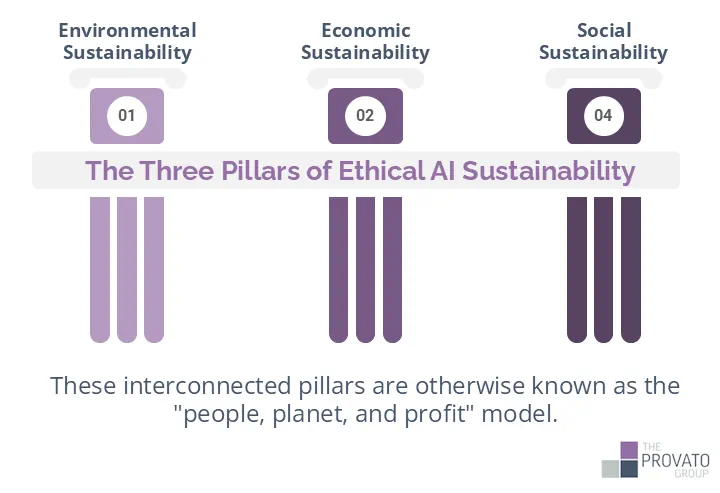
The three pillars of sustainability are:
- Environmental Sustainability
- Economic Sustainability
- Social Sustainability
These interconnected pillars are otherwise known as the “people, planet, and profit” model. In order for AI to be truly sustainable, its growth must be balanced across all three of these dimensions to ensure lasting social well-being and ecological health.
According to the 2018 paper Three pillars of sustainability: in search of conceptual origins by B. Purvis the three pillar concept came from critiques of the economic status quo and the United Nations’ desire to reconcile economic growth and ecological problems.
What Are Sustainable AI Practices?
Sustainable AI practices are made up of a collection of techniques from each of the three pillars that form a holistic approach to designing, developing, and deploying environmentally, socially, and economically responsible AI systems.
Environmental Practices
Environmental practices for sustainable AI include:
- Improving model optimization and algorithmic efficiency
- Using green (renewable) energy sources and infrastructure
- Manage AI impact over its complete product lifecycle
These practices focus on reducing the energy and water consumption of large scale models and data centers.
Social Practices
Social practices for sustainable AI include:
- Mitigate bias and promote fairness in the system
- Data governance and privacy by design
- Build models with explainability and transparency
- Maintain human-in-the-loop control to maintain human values
Social AI sustainability practices promote fairness, fight bias, encourage transparency and protect the well being of humans.
Economic Practices
Economic practices for sustainable AI include:
- Improving resource efficiency and reducing waste or other byproducts
- Avoid economic disruption while also prioritizing human labor rights
- Balance innovation and impact, governing the project with sustainability at the forefront
Economic AI sustainability practices strive to build enduring financial health in a manner that is equitable and just.
How to Use AI Sustainably
Methods for using AI sustainably include:
- Be sure to select the correct use case and algorithm for the problem you are trying to solve
- Consider using composite AI which uses network structures to solve a wider range of problems more efficiently
- Manage where and how AI is used so it doesn’t do unnecessary work or run unused in the background
- Train the AI models only up to where results flatten out and reuse models that have already been trained
- Predict and track environmental outcomes by treating it as a KPI in your cost/benefit analysis
- Attempt to offset your carbon footprint with renewable energy use
How to Make AI More Sustainable
Ways to make AI more sustainable include:
- Work to minimize the AI compute needed by removing unnecessary steps while maintaining key features, user control, and human oversight
- Implement auto-scaling for compute and network resources in match real-time demand with the goal of predicting peak usage and eliminating bottlenecks
- Be sure that the hardware used for AI compute is built with energy efficient CPUs and GPUs to reduce water hungry cooling needs and lower energy costs
- Fully integrate sustainability through energy use monitoring and optimization, prioritize green energy sources, and recycle decommissioned components once their service life has ended
If you are building your own AI infrastructure, there are some additional considerations to keep in mind.

How to Build Sustainable AI Infrastructure and Data Centers
Steps to build sustainable AI infrastructure and data centers include:
- Power your operation with clean energy that can scale; use solar and thermal in the short term while investing in nuclear or geothermal for the long run
- Attempt to go completely grid-free, but grid-light if not by generating and storing energy on-site which also opens up having data centers in new regions that grid-dependent competitors can’t leverage
- Prioritize the uptime of energy storage to deliver steadier round-the-clock power with reduced hiccups; thermal storage is an excellent option
- Start planning for your future immediately meeting surges with solar while permits and infrastructure for nuclear/geothermal are filed or begin construction
- Focus on policy and purchasing efficiency by removing communication bottlenecks, streamlining permit acquisition and lock in long term power contracts well in advance
How to Implement a Sustainable AI Strategy
Follow these steps to implement a sustainable AI strategy:
-
Identify and Define High Impact Use Cases
Don’t chase trends. Develop a strategy that is aligned with your business problems and opportunities. Start with pilot projects and build momentum towards organizational transformation.
-
Prepare Your Organization
Audit and evaluate your existing data, talent, and AI maturity. Proactively address issues around data quality, silos, and accessibility before AI development and implementation begins.
-
Invest in AI Skill Development
Either fill talent gaps with new hires with expertise or upskill existing employees. Build a culture of continuous learning and improvement as AI advances over the course of time.
-
Create A Holistic Ethical Framework
Prepare staff with rules and frameworks for using AI ethically. Integrate specialists in ethics or legal compliance directly within the teams that may need it the most and to monitor AI output.
-
Establish Baselines and Monitor Changes
Before you begin a project, establish KPIs and other important metrics related to sustainability the measure over the course of time. Regularly compare the predicted and actual outcomes.
-
Plan For The Future
Prioritize modularity from the start to allow for agility and future integrations without expensive rewrites. Have a plan in advance for how to thoughtfully scale when the time is right.
What Are the Cost Savings From Sustainable AI Strategies?
Cost savings from sustainable AI strategies and their results include:
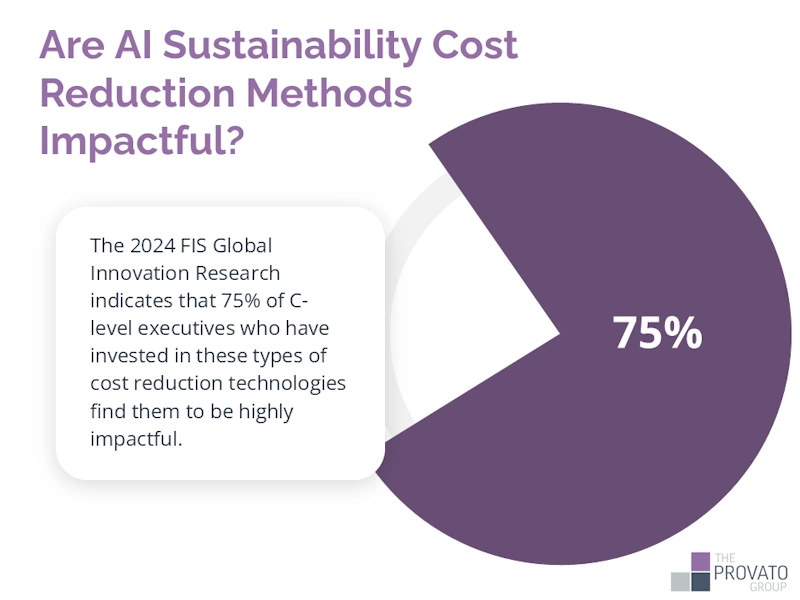
- Supply Chain Optimization has been reported to produce up to a 15% cost reduction within 3 years of investment in AI-driven automation
- Improving Energy Efficiency is a method backed by research that shows approximately 8% to 19% reduced building energy consumption by 2050, while Google’s DeepMind AI reduced energy needs for cooling their data centers by a massive 40%
- Reducing Maintenance Costs with sustainable AI strategies lead one company to reduce downtime by 50% and maintenance costs by $1 billion per year
- Streamlining Human Resources with AI sustainable strategies lead Walmart to a 15% reduction in labor costs, while another company projects $100 million in cost savings
- Customer Support Services can cut costs by up to 30% with AI chatbots with Vodafone seeing a 70% reduction in cost-per-chat, and Klarna’s AI assistant manages two-thirds of its customer chats, adding $40 million in profit for the year 2024
Implementing sustainable AI for cost savings is an ongoing process that requires continuous monitoring but pays off through both automation and more actionable insights that lead to better decision making.
Sustainable AI Sectoral Cost Savings and Efficiencies
| Cost Saving Mechanisms | Reported Cost Savings and Outcomes | Sector or Use Case | Citations |
|---|---|---|---|
| Resource optimization, waste reduction, recycling through machine learning and reinforced learning AI systems | Up to 15% reduction in operational costs; 12% less raw material use, 25% improve in material recovery | Manufacturing, Closed-Loop Manufacturing (CLM), Multiple Additional Industries | Besigomwe, K. (2024). AI-Driven Process Design for Closed-Loop Manufacturing, Matin, A., Islam; M., Wang, X., Huo, H., & Xu, G. (2023). AIoT for sustainable manufacturing: Overview, challenges, and opportunities |
| Smart materials, predictive analytics, energy optimization, design optimization | 10–30% reduction in total costs; 25% less material waste; 17.6% operational cost reduction; 13.2% maintenance cost reduction; 14% energy savings | Construction, Use and Maintainence of Buildings, Smart Buildings | Alghusni, T., Massoud, H., & Yousif, M. (2025). AI-Driven Smart Materials in Sustainable Construction: Maximizing Efficiency, Cost Savings, and Environmental Performance; Adewale, B., Ene, V., Ogunbayo, B., & Aigbavboa, C. (2024). A Systematic Review of the Applications of AI in a Sustainable Building’s Lifecycle |
| Predictive analytics, automation, patient engagement, Artificial Neural Networks (ANN) driven accuracy | €900M saved over 5 years (readmissions); 30% lower admin costs; 40% decrease in staff overtime hours; increased follow-up rates by 15%; an additional €120 million in revenue over five years | Healthcare | Das, R., Suneela, B., Akula, D., Saurav, S., Tyagi, S., & Rani, E. (2025). Integrating AI-Driven Data Analytics into Healthcare Business Models: A Multi-Disciplinary Approach; Alnasser, B. (2023). The Economic Impact of Artificial Intelligence on Healthcare: A Literature Review |
| AI-driven process optimization, predictive maintenance, route optimization to reduce carbon footprint, waste minimization, new job oppurtunities | 30% reduction in stock, lower scrap rates, improved forecasting, 15% cost reductions, 20-35% improved accuracy | Supply Chain and Logistics | Cannas, V., Ciano, M., Saltalamacchia, M., & Secchi, R. (2023). Artificial intelligence in supply chain and operations management: a multiple case study research; Yaiprasert, C., & Hidayanto, A. (2024). AI-powered ensemble machine learning to optimize cost strategies in logistics business |
| Model simplification, phased model training, hyperparameter tuning, edge processing, Green AI | Over 60% reduction in computational costs, up to 115% energy savings with 50% being common and 13% being the low end | Edge and IoT Computing | Gómez-Carmona, O., Casado-Mansilla, D., López-De-Ipiña, D., & García-Zubía, J. (2022). Optimizing Computational Resources for Edge Intelligence Through Model Cascade Strategies; Verdecchia, R., Sallou, J., & Cruz, L. (2023). A systematic review of Green AI |
| AI-driven cost management, resource allocation, improved firm sustainability, automation driven and smart waste reduction, resource utilization optimization | Higher ROI, improved profit margins, reduced resource use, increased EBITDA, reduce operating expenses (OX), higher market valuations via Discounted Cash Flow (DCF) | General Business, Financial Services, Customer Support, Transportation, Professional Services, Small and Medium-Sized Enterprises (SMEs) | Moro-Visconti, R., Rambaud, S., & Pascual, J. (2023). Artificial intelligence-driven scalability and its impact on the sustainability and valuation of traditional firms; Soomro, R., Al-Rahmi, W., Dahri, N., Almuqren, L., Al-Mogren, A., & Aldaijy, A. (2025). A SEM–ANN analysis to examine impact of artificial intelligence technologies on sustainable performance of SMEs; Li, N., & Huang, F. (2024). Evaluating the Financial Returns on Investment in Sustainable Enterprise Digitalization Initiatives Using AI Information System |
What Are the Negative Environmental Impacts of AI?
The negative environmental impacts of AI include:
- High electricity consumption during training; extensive computing time for training escalates AI emissions
- Continued demand for a massive amount of electricity once the model is used in production
- Freshwater-intensive training contributes to water shortages
- Potential increase in resource usage like water and raw materials
- Contributes to electronic waste generation; energy consumption leads to air pollution
- May exacerbate existing environmental issues
- Generates CO2 emissions comparable to aviation, affecting marginalized communities
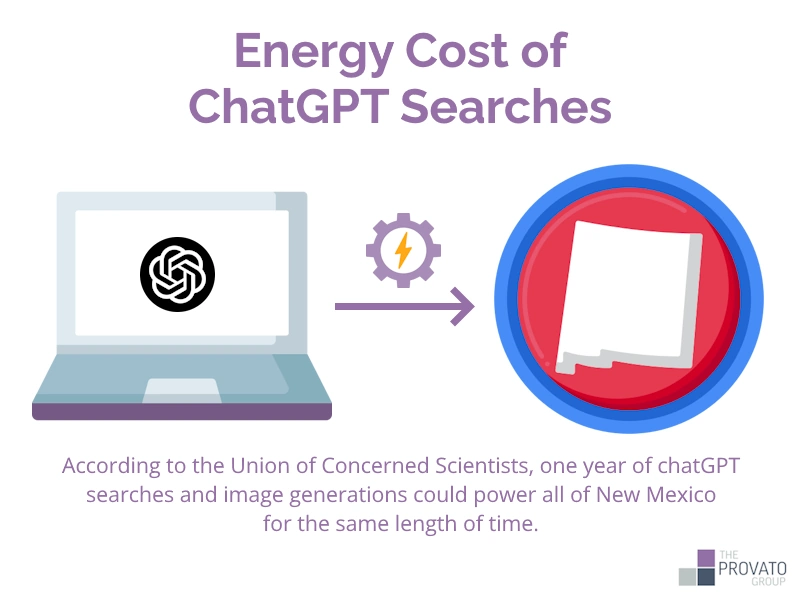
Training AI requires a massive amount of electricity, which is largely produced from fossil fuels unless green energy sources are available and cost efficient. Even after the AI is trained, its continued usage represents an enormous demand of electricity. According to the U.S. Office of Energy, Efficiency, and Renewable Energy data centers account for roughly 2% of the total electricity usage in the United States. While those data centers are also responsible for other types of computational work, many of them house AI and machine learning systems.
According to a recent report by the Lawrence Berkeley National Library, data centers in the United States consume 66 billion liters of water directly at their facilities in 2023.To put that into perspective, that is more than the yearly water use of everyone who lives in Atlanta.
O’Donnell and Crownhart’s calculations in a MIT Technology Review report published in May of 2025 shows that a single query for a small AI model consumes 114 joules, which is about the same as running a microwave for one-tenth of a second. Large models have far greater demands and can use 6,706 joules per response. To make that more relatable, according to the report that is enough energy to run a microwave for eight seconds or carry a person 400 feet on an e-bike.
The energy consumption one prompt may not strike you as that demanding, but the massive amount of electricity used becomes much more obvious at scale. The same article from MIT’s Technology Review states that the electricity needed to process AI prompts in a single day is the same amount of power used by over 3,000 homes a year!
Policy & Standards
What Policies Are Being Considered to Regulate AI’s Environmental Impact?
The policies being considered to regulate AI’s environmental impact include:
- Artificial Intelligence Environmental Impacts Act of 2024 (S. 3732 / H.R. 7197)
- EPA comprehensive lifecycle study (energy, water, pollution, e-waste)
- NIST-guided voluntary environmental reporting system
- Stakeholder consortium to develop measurement standards
- EU AI Act requirements
- Classifies environmental harm as “high-risk”
- Transparency/disclosure for high-impact foundational models (including energy-efficiency reporting)
- Encouraged codes of conduct to reduce environmental impact
- UNEP-supported regulations requiring disclosure of AI environmental impacts; encouragement of efficient algorithms and greener data centers
- Data-center moratoriums/limits (e.g., Frankfurt, Singapore)
Policy-driven technology standards include the following:
- NIST draft guidance on generative AI (supplement to AI RMF) recommending assessment/documentation of environmental impact
- Voluntary reporting practices (document anticipated impacts; verify carbon capture/offset effectiveness)
Alternative policy approaches include the following:
- Emissions/energy credit trading to incentivize low-power, efficient AI
- Targeted innovation incentives (tax breaks, grants) for sustainable AI
- Integrating tech and climate policy (align AI with green transitions; curb AI for enhancing fossil-fuel extraction)
The main strategies of these policies revolve around regulating data center operations, encouraging transparent reporting of AI’s environmental impacts, and the development of “Green AI” technologies.
In order for these policies to be successful, and overcome the main obstacles they face, collaboration between industry experts, academia, and policymakers will be required to develop thoughtful policies, community engagement, and industry standards.
What Are the Main Obstacles to Creating Global AI Environmental Standards?
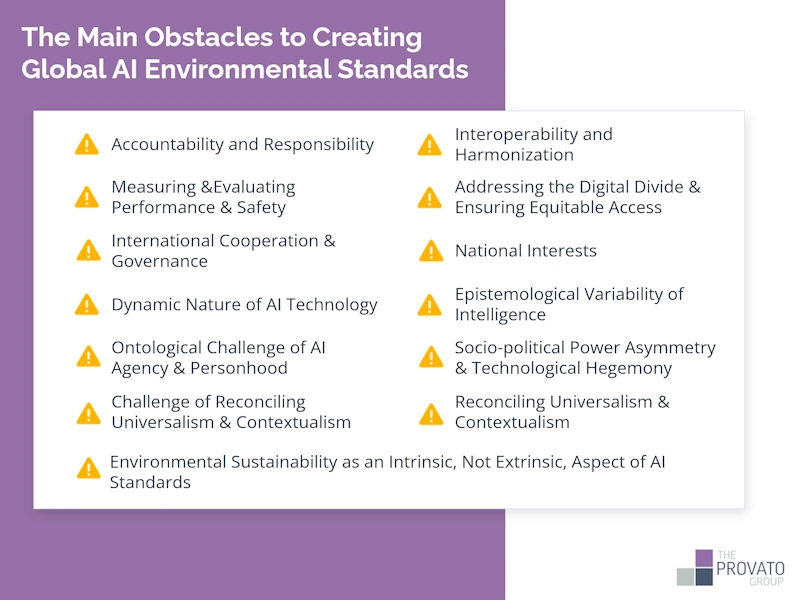
The main obstacles to creating global AI environmental standards include:
- Establishing accountability and responsibility for AI systems considering they are becoming more autonomous and capable of making decisions with serious consequences on their own
- Interoperability and harmonization across different AI systems and platforms which is challenging due to the rapid pace of innovation in the space
- Measuring and evaluating AI performance and safety which is challenging as there’s no established way to determine if AI systems are meeting set standards
- Addressing the digital divide and ensuring equitable access to AI benefits to be sure that any policies created don’t hinder the participation of developing countries and marginalized communities
- International cooperation and governance is need as AI is a global technology that will require shared frameworks and principles to coordinate regulatory efforts
- National interests and geopolitical tensions makes finding a balance between national sovereignty and international cooperation a potential roadblock in the creation and enforcement of global standards
- The dynamic nature of AI itself may cause any standards developed today to become quickly outdated as the technology advances
- The epistemological variability of intelligence makes establishing what is considered intelligence and how to measure that intelligence on a global scale difficult
- The ontological challenge of AI agency and personhood makes standardization efforts more complicated as systems become more sophisticated and exhibit behaviors that resemble human agency
- The socio-political dilemma of power asymmetry and technological hegemony presents a significant challenge because the development and deployment of ai are not occurring in a level playing field
- Environmental sustainability as an intrinsic, not extrinsic, aspect of artificial intelligence standards makes standardization difficult with sustainability being viewed as an add-on, not the end goal
- The challenge of reconciling universalism and contextualism is difficult as finding the balance between universal principles and contextual adaptation is going to require nuance
- The inherent limitations of formal standardization processes as a slow, bureaucratic consensus driven task does not fit well with the rapid advanced of AI technologies
How Can AI Development Companies Promote Sustainability?
More often than not, clients trust their developers to build solutions that meet industry standards and expectations in all areas. As an AI development company ourselves, we promote sustainable AI development practices such as using existing models, making sure the models are the right size and simplify them where possible, and practice sustainable strategic AI integration.
What is Sustainable Strategic AI Integration?
In short, strategic AI integration is the practice of using AI systems only when they are most effective and necessary to solve the business problem being addressed. We evaluate if less energy-intensive technologies and solutions can be leveraged to achieve the desired outcome first, saving the use of artificial intelligence for when and where it’s really needed. Often times, we will build custom AI models to help drive sustainability as well.
To improve sustainability efforts, our team integrates AI solutions only when they are the best option.

How Do Custom AI Models Drive Sustainability?
It all comes back to responsible implementation practices. Custom AI model development often means building smaller, lightweight, domain-specific models. These specialize models are very efficient with their energy and resource consumption compared to larger, general purpose models, while also allowing us to keep tighter control over fairness, transparency, and ethical considerations.
Determining when custom model development is needed often occurs during project discovery or the consulting phase.
How Does AI Consulting and Project Discovery Play a Role in Sustainability?
The two tasks play a huge role in sustainability by identifying and prioritizing solutions that drive environmental responsibility from the start.
Through AI consulting, organizations are guided through the process of adopting AI, with a needs assessment and strategy often being where environmental impact and optimization is identified by the consultant(s).
When hire as the primary development, we identify these opportunities during AI project discovery. By using a data-driven approach, we are able to make sure projects are well defined and align with sustainability goals from the start and throughout the lifecycle of the solution.
How Can AI Be Used for Sustainability?
AI can be used for sustainability in the following ways:
- Climate monitoring and prediction
- Sustainable urban planning and development
- Environmental monitoring and prediction
- Recycling and efficient waste management
- Sustainable agriculture
- Promoting circular economy
The role AI can play in sustainability and stalling, if not reversing climate change is greatly undervalued. The above list gives you an overview of the ways AI can improve sustainability, but lets look at some more specific examples and how they might apply to individual industries.

How AI Can Enhance Strategic Decision-Making for Sustainability
Yes. According to the 2024 paper Artificial Intelligence and Strategic Decision-Making: Evidence from Entrepreneurs and Investors by Felipe A. Csaszar, Harsh Ketkar, and Hyunjin Kim AI can generate numerous environmentally-focused strategic alternatives to human strategies that firms might not otherwise consider. AI’s main value in sustainability decision making rests in its ability to rapidly explore and evaluate a broader range of options while helping organizations consider long-term, more complex scenarios that traditional planning allows.
The researchers show that AI is capable of conducting complex planning for climate futures, virtual stakeholder engagement, overcome cognitive limitations, and address challenges such as speed, complexity, and innovation to propose decarbonization strategies, approaches to circular economies, and supply chain improves at unprecedented speed and scale.
AI in Sustainability Management for Businesses
Based on the 2023 study Adopting artificial intelligence in sustainable business by Juha Sipola, Minna Saunila, and Juhani Ukko, AI was shown to have three categories of sustainability management applications for businesses, which are similar to the three pillars of AI ethics:
- Social sustainability (worker safety, health monitoring, and human resource optimization)
- Ecological sustainability (energy grid optimization, waste reduction, and resource efficiency)
- Societal sustainability (governance monitoring, social impact analysis, and securing critical societal functions)
The research demonstrated that 80% of the largest Finnish enterprises had adopted AI technologies by 2021, with the majority using these systems specifically to advance their sustainability objectives across these interconnected dimensions.
As AI in sustainability management matures from experimental pilot programs to core business operations, organizations are discovering that these technologies create a degree of business transformation in how they approach environmental responsibility and operational efficiency.

AI for Sustainable Supply Chains
Addressing sustainability in supply chains may be one of the most important areas for AI to be applied to. Because supply chains are global, their environmental impact wraps around the globe. AI can use machine learning to help solve the following supply chain sustainability issues:
- Forecasting helps organizations pinpoint inventory needs, avoid spoilage, overproduction, and landfill filling overstocks at every stage of production
- Demand sensing supports sustainability by adjusting production and procurement to actual demand by calculating the timing and order volume accuracy for each customer
- Promotions planning supports sustainability by actively predicting the impacts of promotions allowing organizations to accurately predict demand, reduce overstocks, and limit the consumption of energy, raw materials, and labor
- Predictive inventory supports sustainability by allowing companies to better understand product behavior to protect freshness, availability, and reduce waste
When companies use AI and ML in supply chains, they can be strategic in how they consume resources and energy, reduce their carbon footprint, create larger profit margins, and improve their ability to measure, track, and report their emissions down to the product level.
How Does AI Contribute to Sustainable Construction Practices?
AI can contribute to sustainable construction in the following ways:
- AI can reduce roughly 25% of excess materials and space that are wasted during the early stages of a project by pinpointing optimal sites and designs
- AI allows for construction companies to use tools like embodied carbon in construction calculators to offer cost and carbon assessments at the same time and with accuracy previously thought impossible; a Seattle project reduced concrete emissions by 16% by using this technique
- AI technologies, such as NLP, streamline the permitting process, reduce resubmissions to lower paper prints, courier emissions, and get projects approved with tight sustainability deadlines more quickly
- Artificial intelligence drives gains in specification management that reduce procurement waste by 18% according to the U.S. Department of Energy
- Proactive contract management with AI improves sustainability as demonstrated in a $220 million dollar project that benefitted from eliminating sustainability-related change orders
- AI based integration across all phases of a construction project boosts sustainability efforts by creating a cohesive ecosystem out of varied sources of data and systems
For construction companies willing to invest in AI today, the payoff isn’t just cleaner construction, but an unmatched competitive advantage in their industry.
AI for Sustainable Agriculture
According to the 2024 research paper Sustainable AI-based production agriculture: Exploring AI applications and implications in agricultural practices by AA Mana, AI can be used to promote sustainability in agriculture in the following ways:
- Precision farming to provide accurate irrigation and fertilization needs, applying them only when and where needed
- Reducing chemical use by targeting specific areas with pesticide or herbicide, minimizing the overuse of chemicals
- Improved crop monitoring and the precise application of resources minimizes agriculture waste
- Optimized operations and resource management powered by AI lowers the overall carbon footprint of agriculture practices
- AI powered autonomous robots and tractors used to perform labor intensive tasks reduce the reliance on human labor
- Regenerative practices are improved through the use of AI tools to analyze the outcomes on soil carbon and tillage
The overall impact of AI in agriculture is the continued preservation of farmland, increased yields with fewer resources consumed, and larger profit margins for the operators.
AI in Sustainable Energy
According to a 2025 article in the Yale Clean Energy Forum, AI supports sustainability in the energy industry through the following:
- Grid management optimization
- Predicative maintenance and safety
- Supply change management
- Reduced emissions
- Guidance on policy and investments
AI is creating a more sustainable energy industry by acting as a layer of intelligent optimization over everything from grids to factory operations. Artificial intelligence’s role in cutting water waste and energy use helps reduce carbon emissions by up to 50% while keeping operators safe and more reliable.
AI in Sustainable Finance
Sustainable finance is the cross roads between environmental, social, and governance (ESG) factors and financial decisions, directing capital towards economic activities that benefit people, profits, and the planet. AI’s role in this is through the following:
- Risk management and ESG integration
- Climate risk modeling
- Impact investing
- Sustainable supply chain management
- Identification of greenwashing risks
Sustainable finance has a lot to gain by integration AI into their operations, assessments, and evaluations. Using artificial intelligence, they will be able to process huge amounts of data to identify investment opportunities, mitigate risks, and drive positive environmental and social impact.
AI in Sustainable Foods
According to the 2025 paper titled Artificial intelligence in sustainable food design: Technological, ethical consideration, and future by S. Harikrishnan AI supports sustainable food systems by:
- Enhancing resource efficiency and waste reduction through predictive analytics and supply chain optimization
- Improving food safety and resilience via enhanced monitoring and risk prediction
- Driving product innovation for personalized nutrition and longer shelf life
The researchers found that AI is able to do these things through predictive analytics, machine learning, and automation across the supply chain. AI was the primary driver in precision agriculture to minimize resource use, accelerating the development of alternative proteins, optimizing logistics and demand forecasting to cut waste, and improved traceability and food safety.
AI in Sustainable Manufacturing
AI can drive sustainability in manufacturing by:
- Driving energy transition strategies throughout the supply chain
- Reducing material waste
- Increasing consumer awareness and demand
- Reducing exploitation
The 2023 research paper Integration of artificial intelligence in sustainable manufacturing: current status and future opportunities by Rohit Agrawal found that Genetic Algorithm (GA), Artificial Neural Network (ANN), and Fuzzy Logic are the most widely used AI techniques in sustainable manufacturing.
However, the research also listed several challenges, including data quality issues and integrating new AI systems with older manufacturing equipment that operators and developers will need to be aware of.
AI for Sustainable Material Design
AI is changing sustainable material design through:
- Discovering new materials
- Optimizing material properties for sustainability
- Predicting environmental impact
- Environmental impact reduction
- Accelerated R&D
- Improved materials data infrastructure
- Autonomous experimentation
Data limitations, diverse and sophisticated production environments, and high development costs all stand in the way of widespread AI for Science (AI4S) implementation. Collaborative partnerships can help firms advance their rate of integration and usher in a new era of sustainable materials design by overcoming these challenges collectively.
AI for Sustainable Technology Solutions
Technology solutions companies are leveraging AI to create sustainable change within the industry. For companies this size, they will often need to partner with cities, governments, researchers, and external businesses to innovate the new technologies needed.
Much of their work will focus on areas we’ve previously discussed such as data center resource optimization, model size and operational efficiency goals, predictive analytics, etc.
Technology companies will often be at the forefront of sustainable efforts as they will normally need to build the tools for themselves first before they can offer them to the public.
AI in Sustainable Fashion
AI is becoming increasingly popular in fashion sustainability initiatives. It is helping by:
- Predicting trends to reduce overproduction
- Helping customers shop used clothing
- Speeding up 3d modeling
- Increasing customer satisfaction
- Improving supply chain transparency
- Improving the design process for less waste
The 2024 paper The Effects of Artificial Intelligence on the Fashion Industry—Opportunities and Challenges for Sustainable Transformation by Jolanta Bieńkowska also highlighted some challenges and costs that organizations must consider. They include things such as data needs, job displacement, and ethical concerns which may be particularly troubling in fashion design.
AI and Sustainability Communications
AI is improving sustainable communications in the following ways:
- Telecommunications: AI optimizes energy use in Radio Access Networks (RAN) core networks, equipment used, spectral efficiency, and monitoring for network anomalies
- Networking: AI can analyze real-time network traffic to adjust capacity, shutdown unused stations, or put equipment to sleep to conserve energy
- Cellular Networks: AI can alleviate some of the growing energy demand from 5G and soon 6G towers by dynamically adjusting transmission power, intelligently managing beam steering, and automating network slicing so that each slice only uses the energy it requires
Using AI for Sustainable Event Management
Just like products, events have lifecycles. AI’s data-driven capabilities evolve traditional event planning into a more eco-conscious process, offering tools for pre-event strategy, on-site execution, and post-event analysis.
Pre-event planning uses AI to guide the initial stages of an event and encourage sustainability from the start. Tools for this include carbon footprint measurement, sustainable venue and vendor selection, attendance forecasting for food and material needs, and sustainable travel with low carbon recommendations.
On-site execution sustainability benefits from AI through energy-efficient venue management, optimized waste management, paperless event experiences, and intelligent crowd management.
Post-event analysis can provide operators with an overview of energy consumption, waste production, and emissions for regulatory compliance (like CRSD), and ease the permit process in the future by making safety and sanitation data readily available. Survey feedback can be processes for KPIs related to sustainability, and it will also add in strategy development for future events based on what was learned.
About The Author
Brian McCracken has been solving complex technology challenges for nearly 25 years. Since joining The Provato Group in 2021 he has focused on helping businesses create web experiences that are both powerful and discoverable.
Brian’s quarter-century in development gives him a practical perspective on AI integration. He’s seen enough technology trends to know which ones deliver real value and which ones are just hype. His approach centers on building AI solutions that actually solve business problems while creating interfaces that users genuinely want to engage with.