


By Brian McCracken, AI Strategy Expert at The Provato Group, combining AI/machine learning and frontend development to create intelligent, discoverable web experiences.
February, 2026
Application reengineering carries significant wins in terms of business impact, risk mitigation, and decision clarity for business leadership. While it’s hard to overlook the benefits of using AI for application modernization, you need to have the right strategy, and understand the costs of doing nothing.
The Real Cost of Legacy Applications
Maintaining legacy applications is often viewed as a safe, cost-saving activity, but underneath that it hides growing technical debt. For every day spent maintaining old infrastructure just to ‘keep the lights on’ is time and money that could be used for innovation. Tech debt has a way of compounding over time, making new integrations and features more expensive and time-consuming to develop. Eventually, your team will spend more time working through decades-old codebases trying to keep the system up and running, ruining your ability to ship new features quickly, and dragging down your time-to-market to a halt in the process. The costs of legacy applications are well-researched. The 2017 paper ‘Legacy system and ways of its evolution’ by Sayed Muqtada Hussain, which found that systems reengineering both reduced costs and accelerated production. An April 2025 Subcommittee on Cybersecurity, Information Technology, and Government Innovation found 80% of IT spending for some federal agencies was on the operation and maintenance of aging systems.
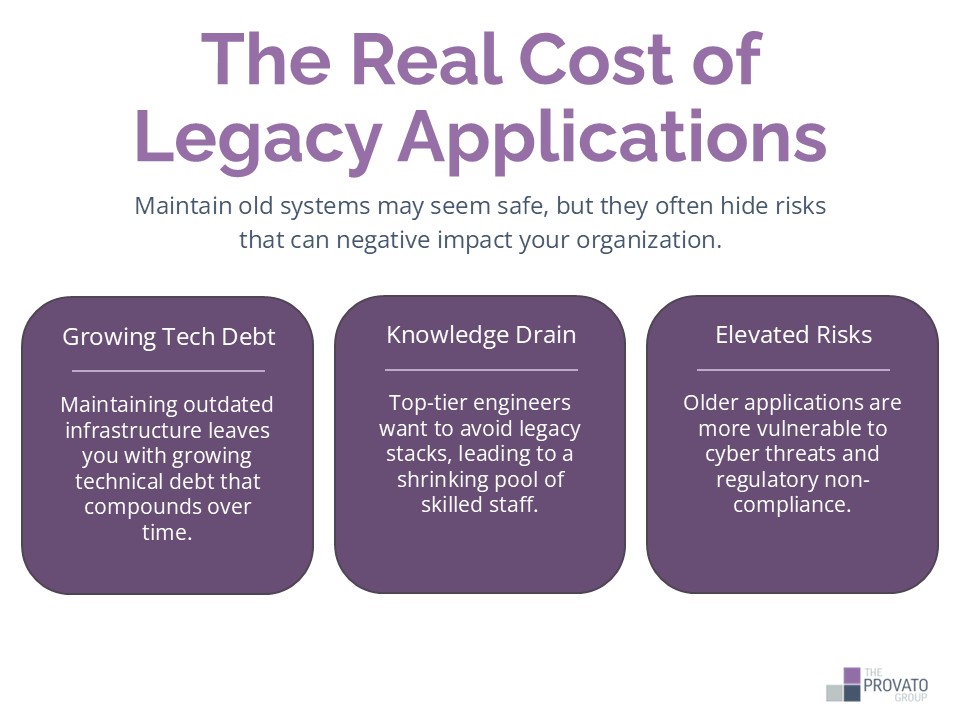
Putting off modernizing applications will create talent gaps in your workforce as well. According to the 2016 paper ‘Analysis of Legacy System in Software Application Development: A Comparative Survey’ by M. Srinivas, one of the key drivers of costs associated with legacy applications is the lack of skilled manpower. Top-tier engineers and analysts want to work in modern stacks. As your seasoned resources retire or move on they will take decades of experience with them. You will be left with a shrinking pool of willing and able new hires and may have to depend on legacy specialists.
Keeping legacy applications in use will create compliance and security costs as well. Older applications weren’t built for today’s threats. M. Srinivas’ 2016 paper demonstrated that while older systems often form the backbone of an organization’s information flow, they aren’t built to cope with today’s business requirements. Older applications often lack the ‘security by design’ employed by modern developers, exposing you to malicious actors that can cause irreparable brand image and regulatory risks.
Where AI Actually Delivers Value in Modernization
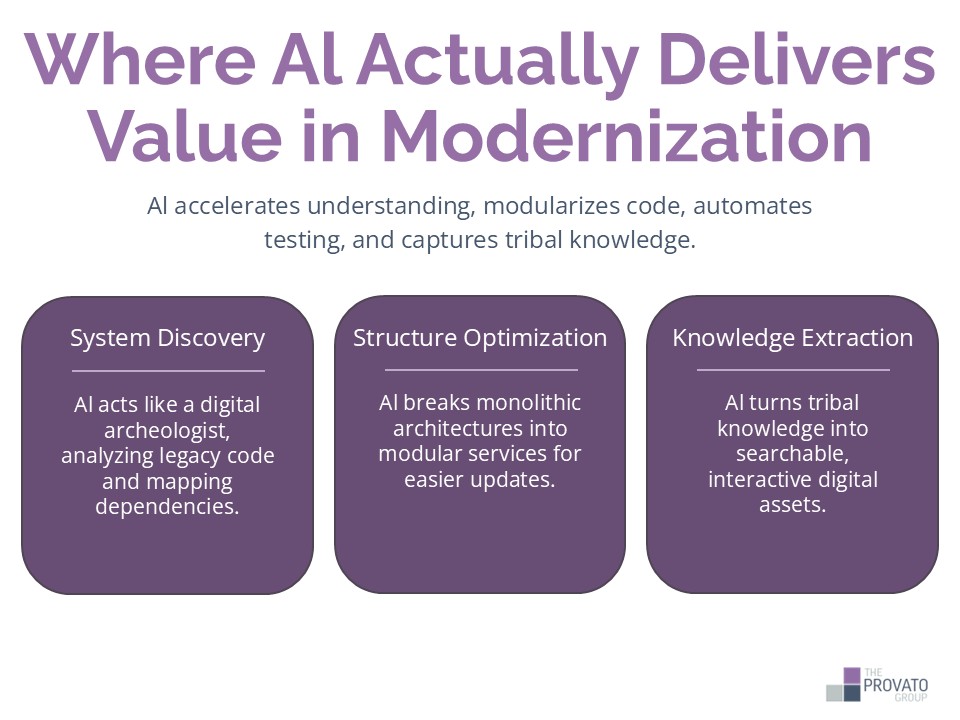
The best way to view AI’s value in software modernization is not in its writing of code, although that’s a big part of it, but in how it accelerates the understanding of complex and messy legacy applications. Modernization efforts often fail because teams are afraid to touch what they don’t understand. It’s the tribal knowledge trap. AI solves this system discovery problem by acting as a digital archeologist, analyzing code and performing dependency mapping to spell out how the software truly works, not how 20 year old unmaintained documentation says it should. AI can find dependencies in legacy applications quickly, allowing developers to cut testing time by 50% in many cases. It gives software engineers the superpower of knowing what will break if a single line of code is changed, which according to the 2023 and 2024 surveys by DevOps.com, drives faster project delivery times for 81% of respondents.
AI-driven app modernization value also comes from structure optimization. AI allows for surgical modularization, breaking monolithic architectures down into highly manageable modular services. Specialized agents are able to collaborate on separate tasks for code translation, validation, and optimization. By working together, the AI agents validate each other’s results through self-improving iterations. According to McKinsey & Co., agent-powered software refactoring is an emerging skill still, but code generation speed is improved by 50% when AI is used.
AI also drives value through automated test generation to ensure behavioral parity with your old systems. According to the 2025 paper ‘AI-Driven Innovations in Software Engineering: A Review of Current Practices and Future Directions’ by M. Alenezi AI test generation produces a 30% reduction in debugging time, and a 20% decrease in post-release defects. AI powered modernization testing catches the weird edge cases during migration, not after your ‘Go-Live’ date.
One often overlooked area in which AI drives value in modernization is through tacit knowledge extraction. By analyzing historical tickets, decisions, and interview transcripts, it builds a knowledge graph. This turns what would otherwise be lost expertise into a searchable, interactive hub. Using AI for modernization converts what would be lost tribal knowledge into a digital asset, cutting documentation time in half, preserving your company’s intellectual property, and provides a persistent mentor for new developers.
Where AI Falls Short (And Why Human Architecture Still Matters)
The ‘boots-on-the-ground’ reality is that AI is great for accelerating application modernization, but only a human can be the true architect. Many business leaders think of AI as a speed multiplier exclusively. Don’t fall into that trap, or you will pay the price when it comes to stability. AI works based on statistical probability, not logical intent. It is fundamentally unable to understand your business logic through pattern matching alone. Sure, it knows what your code looks like, but it doesn’t understand what your specific context or logic must be. Only humans are able to understand the why behind a rule.
App modernization often requires moving some legacy data to the cloud, which often exposes the hallucination issues many AI models share. AI systems default to what is common, not necessarily what is secure for your use case. They can hallucinate entire APIs and libraries that don’t exist, creating brittle systems that seem fine at first, but crash when put under the strain of real user traffic. However humans know the tacit knowledge. They know all of the unwritten rules for your specific environment and needs that a general model could never know.
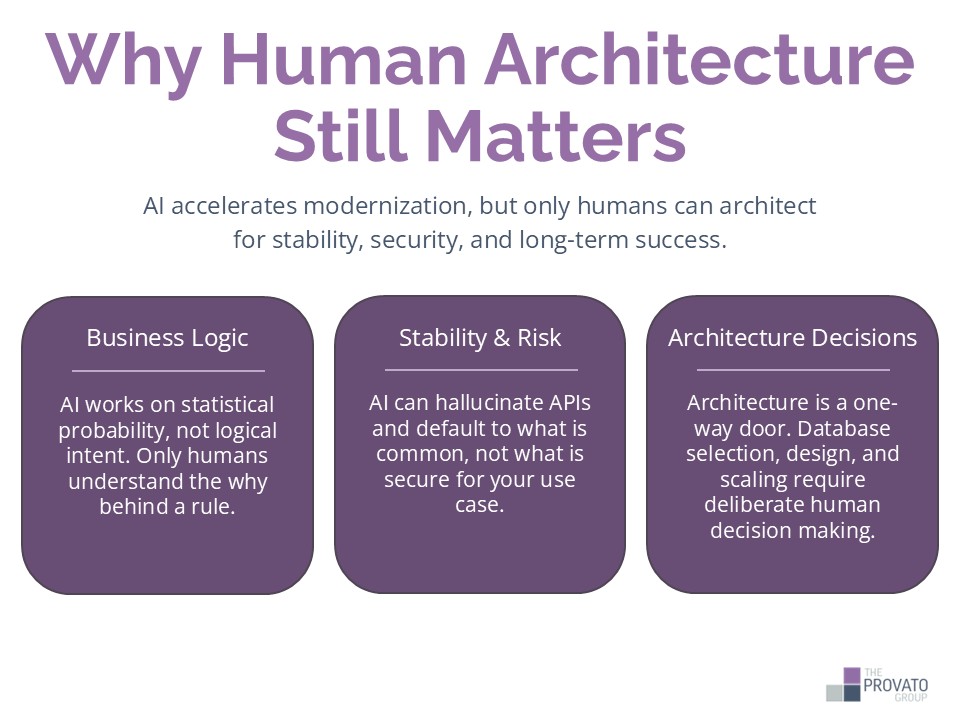
Most importantly, architecture is a one-way door, meaning once a direction is chosen it can be very difficult to change later. While AI might suggest generic patterns, humans are needed to evaluate the long-term scaling and team structure behind the app. Things like database selection and design require deliberate decision making, not pattern matching. This is sometimes known as ‘glue code,” or the code AI generates that can cause tech debt multiplication by creating systems that are so interconnected that isolating individual changes becomes nearly impossible. This ultimately ends up being comprehension debt, where AI starts implementing code that nobody understands.
Our team is aware of all of these pitfalls, and addresses them proactively during the modernization process. We plan ahead to prevent architectural flaws and AI-generated “quick fixes” that will often end up creating code rewrites later. It’s best to think of our approach as a blend between AI-augmented modernization and traditional modernization.
AI-Augmented Modernization vs. Traditional Modernization
AI-augmented modernization uses automated code analysis, conversion, and testing while traditional application modernization requires that these tasks be performed manually. Application modernization with AI assistance is a fundamental strategic shift in thinking that positively impacts:
- Timeline
- Cost
- Risk
- Talent
Timeline: From Years to Months
Traditional application modernization can takes years to complete in some cases, while AI-enable modernization cuts that time down to months. According to the 2025 study ‘AI-Augmented Legacy Modernization: Transforming Enterprise Systems with Smart Automation’ by Lingareddy Annela, enterprise legacy modernization timelines are reduced by 30-50%, and costs see a 25-40% reduction as well. This is further supported by the 2024 paper ‘Enhancing software development practices with AI insights in high-tech companies’ by Daniel Ajiga which found that AI-powered modernization timelines are reduced due to the AI predicting failure points in advance, reducing rework and late defects.
| Aspect | Traditional Modernization | AI-Augmented Modernization |
|---|---|---|
| Assessment Phase | Months of manual code and documentation review | Days to weeks using AI code and dependency mapping |
| Code Transformation | Manual rewriting taking 6–18 months for larger applications and legacy systems | The same work is done 40–70% faster with AI code refactoring |
| Testing & Validation | Time-intensive manual test creation and execution | Reduced QA time by 35–45% with automated test generation |
| Overall Project Duration | Multi-year projects, either all at once or incrementally | 40–50% timeline reduction |
Cost: Low ROI, High Waste
Traditional modernization means that your are paying for the manual labor needed at every step, while AI-enabled modernization shifts that focus to innovation to reduce costs. The 2025 study ‘AI-Augmented Legacy Modernization: Transforming Enterprise Systems with Smart Automation’ by Lingareddy Annela when AI is used in modernization, it improves quality, lowering both risk and rework with 83% fewer critical defects and 76% higher requirement‑fulfillment success in AI-assisted projects. These factors contributed to the 35-40% lower development costs of AI modernization vs traditional approaches.
| Cost Factor | Traditional Modernization | AI-Augmented Modernization |
|---|---|---|
| Upfront Investment | High ($50K–$200K for full rewrites) | Moderate (AI tooling + training costs) |
| Technical Debt Reduction | 10–20% additional project cost to address technical debt | ~40% reduction in tech debt-related costs |
| Labor Costs | Heavy reliance on scarce legacy specialists (average $30M/year per legacy system) | 55% productivity boost in AI-augmented squads; reduced manual effort |
| Maintenance (Post-Modernization) | 20–30% of annual dev budget for legacy maintenance | 30–40% lower maintenance costs after 12–18 months |
| Error/Downtime Costs | High risk of cost overruns; 80% of migrations fail budget/deadlines | Up to 40% fewer errors; predictive analytics prevent costly failures |
Risk: Evidence-Based Security
AI-augmented modernization also greatly reduces risks when compared to traditional modernization efforts. Lingareddy Annela’s 2025 research also found that AI was able to find hidden business rules and undocumented dependencies, while simultaneously generating regression test suites to reduce project failure rates. This is further supported by the 2025 study ‘Intelligent Legacy System Modernization: A Framework for Automated Application Migration using AI/ML/GenAI/LLM’ by Arpita Hajra which showed that AI powered predictive analytics were able to flag migration issues before cutover, reducing outage risks as well.
| Risk Dimension | Traditional Modernization | AI-Augmented Modernization |
|---|---|---|
| Knowledge Loss | High risk: relies on tribal knowledge and undocumented business logic | AI extracts embedded business rules and dependencies from code automatically |
| Behavior Preservation | Risk of unintentionally changing critical system behavior during migration | “Behavior-first” approach locks functionality in through AI-generated tests before changes |
| Project Failure Rate | 79% of projects experience failures, mainly due to skills/process challenges | De-risked through predictive analytics and automated validation |
| Security/Compliance | Legacy vulnerabilities persist during long transformation periods | Continuous monitoring; AI identifies high-risk execution paths pre-migration |
| Operational Disruption | Significant downtime risk during “cut-over” events | Parallel running and incremental deployment minimize disruption |
Talent: Future-Proofing the Team
Traditional modernization work often depends on expensive legacy systems specialists while AI-enabled modernization acts as a bridge so that modern developers can focus on high-level business logic. That means a modernization team doesn’t need to be experts in 40 or 50 year old code. They just need to understand your business goals at a deep level and use AI to support the transition to a new codebase.
| Requirement | Traditional Modernization | AI-Augmented Modernization |
|---|---|---|
| Legacy Expertise | Critical dependency on scarce legacy language specialists (COBOL, RPG, etc.) | Reduced dependency: AI handles code translation; experts focus on business logic validation |
| Modern Development Skills | Large teams of senior engineers for manual rewrite | Smaller teams augmented with AI “copilots”; junior developers can contribute more effectively |
| AI/ML Expertise | Minimal required | Moderate: teams need AI literacy and prompt engineering skills |
| Architectural Intelligence | Senior architects needed for all decisions | AI provides expert-level architectural guidance, democratizing expertise |
| Change Management | Traditional project management | Cross-functional integration required; executive AI literacy essential |
How to Build an AI-Enabled Modernization Roadmap
Building an AI application modernization roadmap is done in four phases:
- Assessment phase
- Tooling strategy
- Governance model
- Measuring ROI
1. Assessment Phase
The assessment phase sets the stage for the entire modernization roadmap. It’s multi-dimensional and not purely technical. If you asked what departments in my company use ChatGPT, would you know the answer? Probably not. Here are the eight assessment areas that need to be considered during this phase.
| Assessment Area | Category | Key Actions / Focus |
|---|---|---|
| AI Use Case Audit | Current State Inventory | Catalog existing AI initiatives across departments to identify “shadow AI” projects lacking formal oversight |
| Technical Debt Assessment | Current State Inventory | Evaluate legacy pipelines and models for missing metadata, monitoring, or documentation required for governance |
| Data Readiness | Current State Inventory | Assess taxonomy, content structures, and data ownership; only 22% of organizations maintain high-quality metadata across assets |
| Stakeholder Impact Analysis | Risk & Value Mapping | Identify who the system affects, what decisions it influences, and consequences of failure |
| Risk Tier Classification | Risk & Value Mapping | Categorize use cases by risk level (low-risk internal tools vs. high-stakes customer-facing or regulated decisions) to determine oversight requirements |
| Baseline Establishment | Risk & Value Mapping | Document current performance metrics (processing times, error rates, costs) to enable before/after comparisons |
| Skills Gap Analysis | Organizational Readiness | Evaluate AI literacy across functions; compare ROI of foundational training vs. specialized technical upskilling |
| Change Readiness | Organizational Readiness | Assess cross-functional collaboration maturity and workflow redesign capabilities |
2. Tooling Strategy
AI costs scale with usage. Bill shock can be a real concern if a tooling strategy isn’t laid out up front. You can think of this as a governance stack over the process. That stack is comprised of a unified access layer acting a single front door for all developers, core platform components to standardize the work, and integration architecture to prevent the unintended creation of new silos in your system.
| Section | Component / Capability | Purpose / Description |
|---|---|---|
| Unified Access Layer | Centralized Model Gateway | Implement unified access controls for models across dev, staging, and production environments to prevent shadow AI proliferation |
| Unified Access Layer | Role-Based Permissions | Integrate with identity management systems to ensure consistent permissions and full audit trails |
| Core Platform Components | Data Governance | Real-time policy checks, PII detection, and metadata standardization |
| Core Platform Components | MLOps / LLMOps | Automated deployment pipelines with built-in compliance checks |
| Core Platform Components | Monitoring & Observability | Track model drift, hallucination rates, and guardrail interventions |
| Core Platform Components | Explainability Tools | SHAP, LIME, or feature importance visualization to ensure transparency |
| Integration Architecture | API-First Design | Ensure tools integrate with existing enterprise systems without creating new silos |
| Integration Architecture | Cloud Cost Management | Budget for potential “bill shock” from variable AI operational costs; AI carries high marginal usage costs compared to traditional SaaS |
3. Governance Model
Our AI-powered modernization services bake governance into the dev-loop roadmap, from documenting data consent to ensuring human-sign off on any releases. We follow a RACI (Responsible, Accountable, Consulted, Informed) model that has three main sections: Structural Elements, Lifecycle Integration, and Automated Safeguards
| Section | Control / Element | Purpose / Implementation Detail |
|---|---|---|
| Structural Elements | Cross-Functional Committee | Standing governance body with authority spanning IT, legal, compliance, privacy, and business units |
| Structural Elements | Clear RACI Models | Define who is Responsible, Accountable, Consulted, and Informed for every AI system |
| Structural Elements | Risk-Based Tiers | Apply lighter documentation for low-risk internal tools; require human-in-the-loop oversight and formal approval for high-risk systems |
| Lifecycle Integration | Define Scope & Intent | Document intended use cases and explicitly define prohibited uses |
| Lifecycle Integration | Document Data Sources | Record ownership, consent status, and data limitations |
| Lifecycle Integration | Establish Evaluation Criteria | Define performance metrics, thresholds, and acceptable trade-offs |
| Lifecycle Integration | Enforce Release Gates | Require named owners, formal sign-offs, and rollback criteria prior to deployment |
| Lifecycle Integration | Monitor & Review | Validate original assumptions against real-world usage and outcomes |
| Automated Safeguards | Input Validation | Catch malformed or adversarial queries before processing |
| Automated Safeguards | Output Filters | Block unsafe content and prevent PII exposure |
| Automated Safeguards | Real-Time Monitoring | Automatically flag unauthorized use, data drift, or bias anomalies |
4. Measuring ROI
Measuring ROI is the final phase of an AI-enabled modernization roadmap. It include three horizons:
| Measurement Horizon | Metric Category | Key Metrics |
|---|---|---|
| Leading Indicators (0–6 Months) | Adoption & Capability Development |
AI tool adoption velocity Time-to-proficiency metrics Cross-functional collaboration indices |
| Operational Metrics (6–18 Months) | Performance & Efficiency |
Productivity Uplift: Hours saved × average hourly value Decision Accuracy: Error reduction rates, rework avoidance Value-Realization Speed: Payback period or benefits captured in first 90 days |
| Business Outcomes (12–36 Months) | Strategic Impact |
Revenue impact from AI-enhanced processes Innovation pipeline velocity (new use cases proposed by trained employees) Competitive positioning improvements |
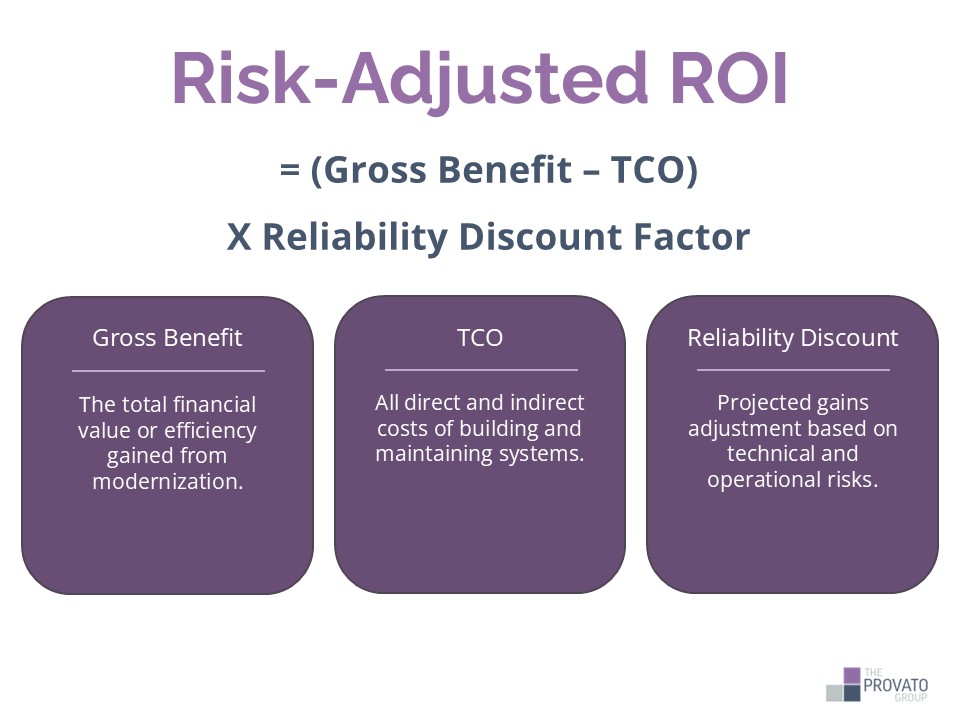
Risk-Adjusted ROI is the gross benefit minus the total cost of ownership x the reliability discount factor of the new, modernized system. In AI code refactoring, total cost of ownership includes integration, evaluation, data handling, prompt engineering, infrastructure, monitoring, and change management.
It’s important to remember that RONI (Risk of Non-Investment) must not be left out of the equation. Sometimes the largest expense isn’t the modernization project itself, but the lost market share to a competitor who automated faster.
Why Pick Us As Your AI-Enabled Application Modernization Partner
The ideal AI-enabled app modernization partner will be able to demonstrate competencies and experience, use a strategic approach to their projects, and offer transparent communication. We’ve been providing legacy application modernization services since our company started. Our AI-powered modernization services take outdated systems and transform them into robust platforms with cutting-edge technologies that drive business value, growth, and efficiency.
We offer a full spectrum of approaches, each catering to the unique needs of every client on an individual basis. These include rehosting, re-platforming, refactoring, re-engineering, rewriting, and encapsulation. Whether it’s microservices adaption, containerization, or data modernization our process ensures minimal disruption to your business operations.
We understand that every business has unique goals. Our approach to custom app modernization design services start with understanding your specific objectives, and then we customize our strategies to meet those needs. This ensures we deliver a legacy web app modernization design solution that provides significant value to your organization.